Product Module
Every Risk Has an Owner. Every Decision Has a Trail.
Consolidate findings, assign remediation with named owners and hard deadlines, document treatment decisions with approver rationale, and deliver a defensible decision trail that survives personnel turnover, audit scrutiny, and insurer due diligence.
Share findings from your last audit, vendor review, or penetration test. We will organize them into a defensible risk workflow with named owners, escalation thresholds, and closure evidence in 15 minutes.
Best fit
Risk & AccountabilityExpand to Reviewer Operations when the workflow broadens.
Best for tracking risks, decisions, and remediation with a reviewable decision trail.
Sample output
Risk decision and remediation tracker
Named ownersTreatment rationaleClosure evidence
The Numbers Behind Accountable Risk Programs
Risk Closure Rate
Risks with assigned owners, deadlines, and linked evidence close at nearly double the rate of spreadsheet-tracked items.
Decision Trail Depth
Every risk acceptance, transfer, and mitigation decision carries approver context and linked rationale reviewers can follow.
Remediation Response Time
Owned remediation tasks with deadline tracking and escalation alerts cut response lag from weeks to days.
Risk & Accountability
Best for tracking risks, decisions, and remediation with a reviewable decision trail.
- Reviewer Operations: Add reviewer-safe exports and request workflows when remediation has to be shared externally.
- ReadyOps: Add training, exercises, and communications records when readiness proof becomes part of the same motion.
Need help choosing?
Compare bundles and module pricing to find the right starting point, then confirm fit in a walkthrough if your workflow is regulated or time-bound.
The Difference Between Spreadsheet Risk And Defensible Risk Management
Without Aurora
- Risk register lives in a spreadsheet that gets updated once a quarter if someone remembers
- Risk acceptance decisions made in meetings with no record of who approved or why
- Remediation items assigned over email and lost in ticket backlogs with no follow-through
- No connection between risks and the controls or evidence that mitigate them
- Insurer asks about your risk posture and the team builds a summary from memory
With Aurora
- Living risk register with real-time status, assigned owners, and automatic review reminders
- Every acceptance, transfer, and mitigation decision documented with approver and linked rationale
- Every remediation task owned, deadline-tracked, and escalated automatically when overdue
- Risks linked to controls, evidence, and remediation work in a single navigable trail
- Risk posture snapshots exportable on demand with trend data and closure evidence
From Audit Finding To Accountable Closure
01
Consolidate findings into a scored risk register
Ingest risks from audits, penetration tests, vendor assessments, and internal reviews. Each finding enters with severity scoring, a named owner, and linked control context from day one.
02
Assign remediation with named owners and hard deadlines
Convert findings into remediation tasks with explicit owners, due dates, and escalation thresholds. Overdue items surface automatically so nothing stalls in silence.
03
Document treatment decisions with approver rationale
Accept, mitigate, transfer, or grant an exception. Every treatment decision records the approver, the rationale, the acceptance window, and the review cadence so the decision trail survives the person who made it.
04
Track risk posture trending across review cycles
Period-over-period snapshots show whether open exposure is shrinking, which remediation deadlines slipped, and where closure velocity is accelerating or stalling.
05
Deliver a defensible decision trail to auditors and insurers
Give external reviewers structured access to treatment rationale, exception approvals, remediation progress, and closure evidence without exposing your full workspace.
Key Capabilities
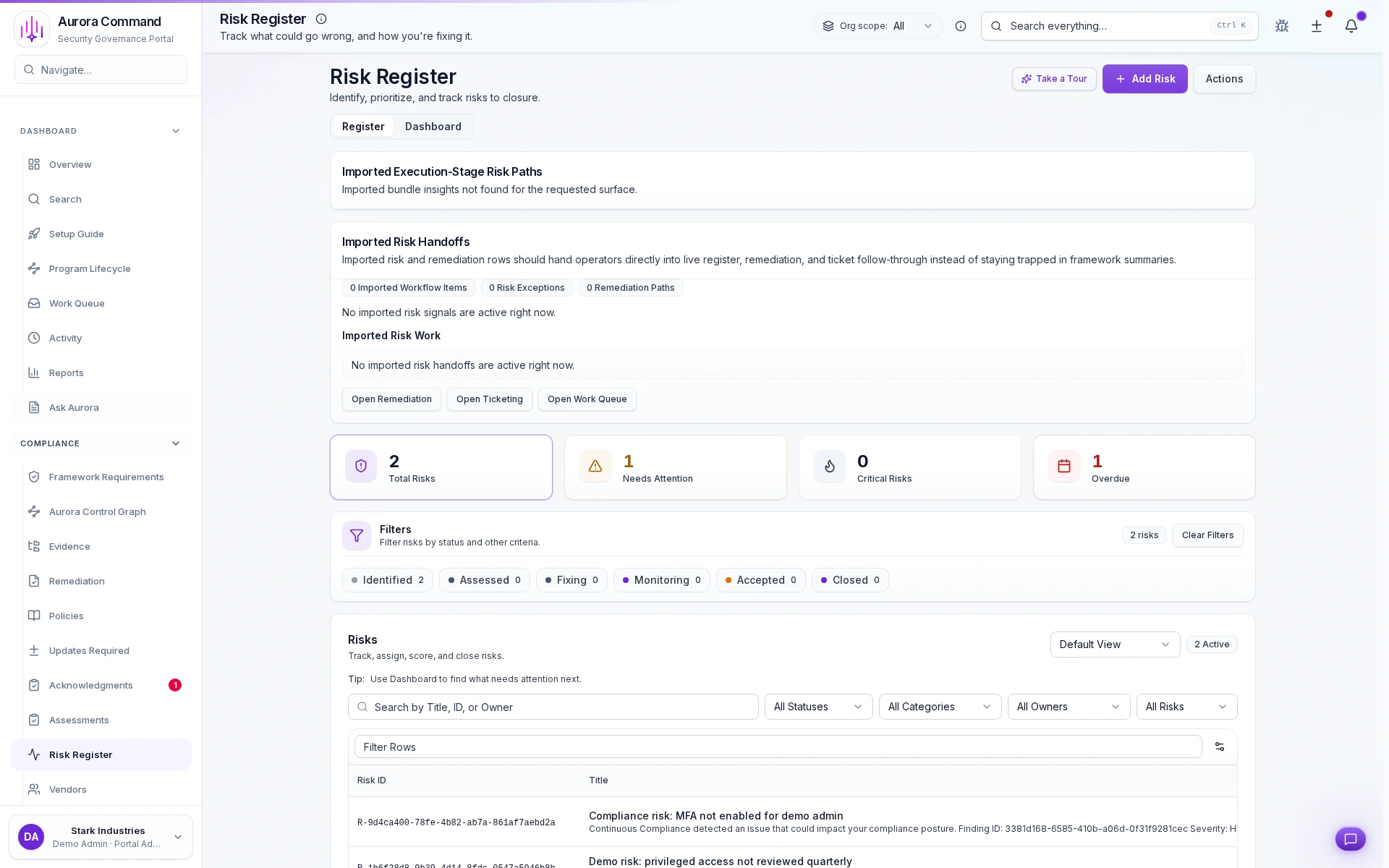
Feature 1 of 5: Scored Risk Register with Named Ownership
1/5
Scored Risk Register with Named Ownership
Every finding carries a severity score, a named owner, a treatment status, and a deadline. Auditors review one record instead of chasing spreadsheets across teams.
Artifacts reviewers recognize, plus sample previews of structure.
Scroll for artifact previews
Pull Risk Context From The Tools Teams Already Use
Extend This Workflow
- Support RequestsStructured request intake with SLA tracking, owner assignment, and resolution evidence.
- Messaging OperationsGoverned communication workflows with delivery tracking and audit-ready message history.
- Vendor Risk ManagementThird-party due diligence, SLA monitoring, and vendor risk scoring in one governed record.
- EvidenceContinuously collect, verify, and refresh compliance evidence from integrations and uploads.
- Operations & AccountabilityCross-module operational oversight with named ownership and deadline accountability.
Questions Teams Ask About Risk & Vendor Management
Can remediation tasks be assigned across teams?
Can remediation tasks be assigned across teams?
Yes. Each task carries a named owner, a hard deadline, and automatic escalation when overdue. Cross-team remediation stays part of the unified risk record so auditors can trace ownership and progress without chasing separate trackers.
How do you handle risk decisions that change over time?
How do you handle risk decisions that change over time?
Every treatment decision is versioned. If you accept a risk today and mitigate it next quarter, both decisions remain in the trail with their respective approver, rationale, and timestamp. The full decision history is preserved so the audit record withstands personnel turnover.
Can we import risks from existing audits or assessments?
Can we import risks from existing audits or assessments?
Yes. Import findings from prior audits, penetration tests, vendor assessments, or internal reviews. Each finding receives severity scoring, a named owner, and linked control context from the moment it enters the register.
How does risk posture trending work?
How does risk posture trending work?
Aurora compares open exposure, remediation velocity, SLA breach frequency, and closure rates across review periods. Present board-ready posture improvement data to auditors and insurers instead of anecdotal progress updates.
How are vendor risks integrated into the risk register?
How are vendor risks integrated into the risk register?
Vendor due diligence findings, SLA obligations, and outstanding remediation items flow into the same risk register as internal findings. Each vendor risk carries its own owner, treatment decision, and review cadence so third-party exposure is governed with the same rigor as internal risk.
How does exception handling work?
How does exception handling work?
Exceptions require an approver, a written justification, an acceptance window, and a scheduled review cadence. Compensating controls are documented alongside the exception. When the acceptance window expires, the exception resurfaces for re-evaluation so nothing stays silently accepted.
Stop Accepting Risk Without A Decision Trail That Outlasts The Approver
Share your current risk register or vendor review backlog. We will show how Aurora connects treatment decisions, exception rationale, remediation deadlines, and closure evidence in one defensible record.
Share your top open risks or remediation queue. We will show how Aurora ties owners, dates, and closure evidence together.