Evidence that breathes, not evidence that sits
Evidence That Stays Current Between Review Windows
Continuously collect connector-backed, upload-based, and attestation-driven evidence in one living library. Freshness counts down in real time, coverage gaps surface the moment they open, and every artifact traces back to its source -- so reviewers validate the record without a single follow-up.
Describe an evidence gap, an upcoming audit window, or a stale-artifact concern. We will show how Aurora turns it into continuously verified, freshness-tracked proof in under 15 minutes.
Best fit
Continuous ComplianceExpand to Risk & Accountability when the workflow broadens.
Best for automated evidence capture and scheduled checks between review windows.
The Numbers Behind Continuously Fresh Evidence
Evidence Freshness Rate
Automated collection and scheduled refresh keeps evidence current between review windows, not rebuilt the night before.
Faster Evidence Collection
Integrations pull evidence artifacts automatically instead of manual screenshot-and-upload workflows.
Audit-Ready Export Time
Point-in-time evidence bundles assembled and exported in hours, not the weeks teams spend rebuilding from scratch.
Continuous Compliance
Best for automated evidence capture and scheduled checks between review windows.
- Risk & Accountability: Add remediation and accountable follow-through when evidence gaps start generating real work.
- Command: Add on-prem collectors and unexpected-change evidence where needed.
Need help choosing?
Compare bundles and module pricing to find the right starting point, then confirm fit in a walkthrough if your workflow is regulated or time-bound.
The Difference Between Stale Folders And Living Evidence
Without Aurora
- Evidence lives in folders nobody maintains. Screenshots from six months ago passed off as current
- Manual screenshot-and-upload workflows that take hours per control and break every quarter
- No way to tell which evidence maps to which control without cross-referencing spreadsheets
- Auditor asks for point-in-time evidence and the team rebuilds it from memory and email threads
- Evidence collected once for one audit, then thrown away and rebuilt for the next
With Aurora
- Every artifact carries a freshness timestamp and automatic alerts when evidence goes stale
- Integrations pull evidence automatically from source systems on a schedule you define
- Every artifact linked to its control, policy, and review requirement in one navigable record
- Point-in-time snapshots assembled automatically with version history and chain of custody
- Evidence library persists across cycles. Reuse, refresh, and extend instead of rebuilding
From First Capture To A Continuously Governed Evidence Package
01
Ingest evidence continuously from every source
Connectors pull artifacts on schedule, teams upload manually when needed, and attestation workflows capture human confirmations. Every piece arrives with provenance metadata, an assigned owner, and a timestamp that starts the freshness clock.
02
Map artifacts to controls in real time
Link each piece of evidence to the control requirements it satisfies. Coverage gaps surface instantly across every mapped framework, so your team closes them before a reviewer ever asks.
03
Monitor freshness and flag expiring proof
Validity windows count down automatically. When evidence approaches expiration, Aurora alerts the owner and queues re-collection, surfacing what is current, expiring, or stale well before review week begins.
04
Freeze snapshots for audit windows
Lock evidence state at any point in time. Auditors see exactly what was true during the review period, with change logs that explain every delta between consecutive snapshots.
05
Export governed packages through controlled access
Bundle timestamped, owner-attributed artifacts into structured packages and deliver them through Trust Center tiers. Reviewers get the proof they need without workspace exposure.
Key Capabilities
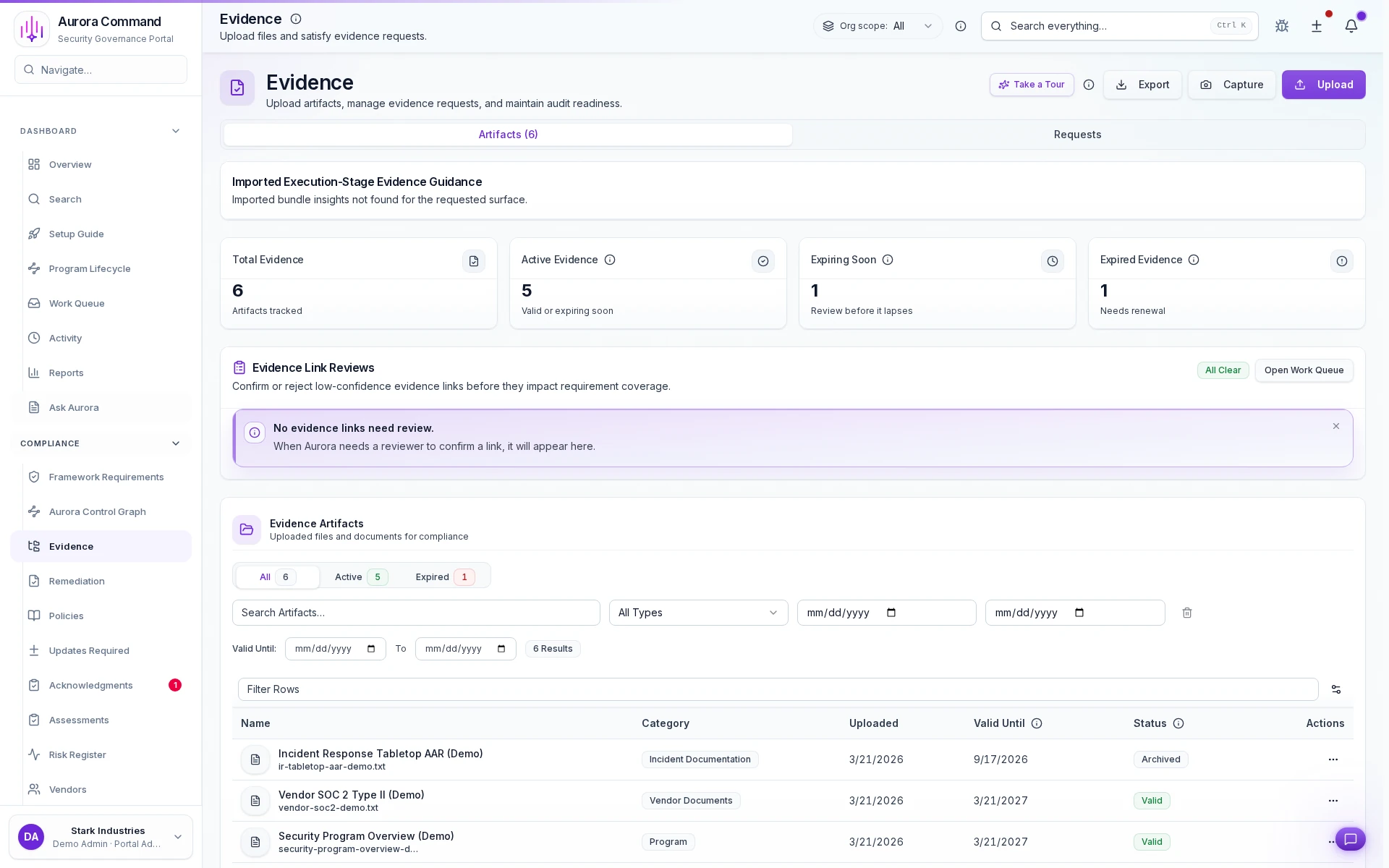
Feature 1 of 6: Continuous Automated and Manual Intake
1/6
Continuous Automated and Manual Intake
Connectors pull evidence on recurring schedules while teams upload manually when needed. Both streams carry explicit ownership and provenance, so your evidence library grows continuously without single-source fragility.
Artifacts reviewers recognize, plus sample previews of structure.
Scroll for artifact previews
Pull Evidence From The Tools Teams Already Use
Extend This Workflow
Questions Teams Ask About Continuous Evidence
Can we start with manual uploads and add integrations later?
Can we start with manual uploads and add integrations later?
Absolutely. Upload evidence manually from day one. Every artifact gets the same provenance metadata, ownership, and freshness tracking regardless of source. When you connect integrations later, automated collection layers in alongside manual uploads without disrupting existing mappings or coverage views.
How does continuous freshness tracking prevent audit surprises?
How does continuous freshness tracking prevent audit surprises?
Every artifact carries a validity window that counts down in real time. As evidence approaches expiration, Aurora notifies the assigned owner and queues re-collection. Stale items surface immediately in coverage views and dashboard alerts, so your team resolves gaps weeks before review week, not the night before.
What happens when evidence changes between snapshots?
What happens when evidence changes between snapshots?
Snapshots freeze evidence state at a tamper-evident point in time. Any changes after the snapshot are tracked in a separate delta log with timestamps and source context. During audit, you can show exactly what was true in the review window and explain every subsequent change with full traceability.
Can one piece of evidence satisfy multiple controls across frameworks?
Can one piece of evidence satisfy multiple controls across frameworks?
Yes. Map a single artifact to every control it supports across any number of frameworks. Coverage views update simultaneously across all linked controls, and freshness alerts apply universally, so one renewal keeps every mapped requirement current.
How does Aurora ensure evidence integrity for external reviewers?
How does Aurora ensure evidence integrity for external reviewers?
Every artifact is stored with a cryptographic hash and an append-only timestamp. Snapshots are tamper-evident, change logs capture who modified what and when, and export bundles carry verification metadata. External reviewers can independently confirm that nothing was altered after the fact.
Aurora Command does not guarantee compliance outcomes. It helps you organize and document the work.
Stop Rebuilding Evidence The Night Before Every Audit
Describe one audit window, security review, or evidence gap. We will show how Aurora keeps your proof continuously fresh, governed, and ready to export so review week is a formality, not a fire drill.
Share your current evidence folder or stale-artifact list. We will show how Aurora turns it into a governed, current library.