Product Module
Response Records That Survive the Insurer's Second Question.
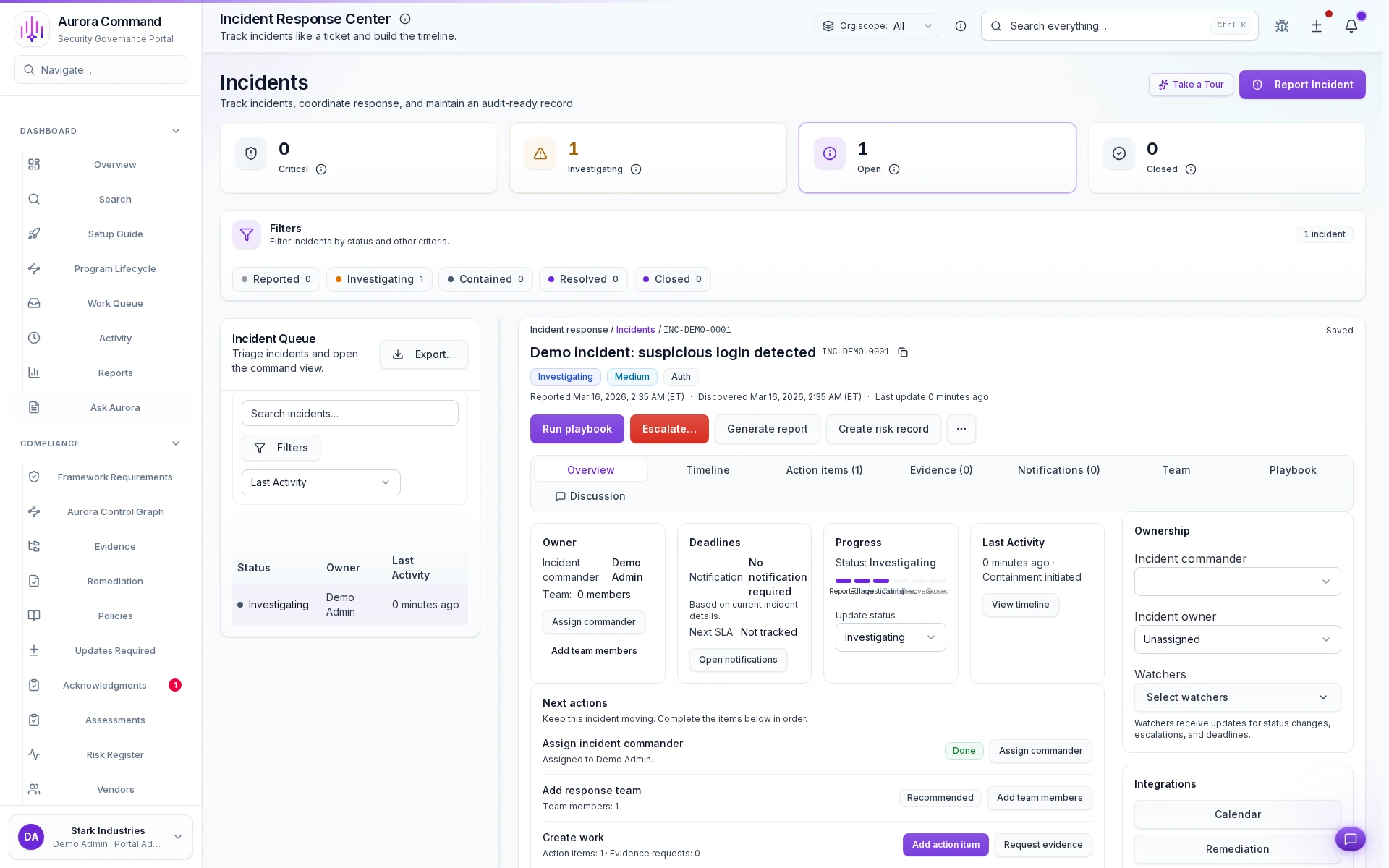
Version every runbook, assign incident roles with coverage-gap alerts, run exercises with MTTA/MTTR timelines, and track every remediation to documented closure, so when the insurer asks "are you prepared?" you show them, not tell them.
Name the IR control your insurer asked about last. We will show how versioned runbooks, exercise timelines, and remediation closure evidence connect in under 15 minutes.
Best fit
Response ReadinessExpand to Readiness Suite when the workflow broadens.
Best for tabletop exercises and readiness records insurers can review.
Sample output
Versioned incident response plan
Runbook Version HistoryRole Accountability MatrixMTTA/MTTR TimelinesRemediation Closure
The Numbers Behind Audit Ready IR Programs
Faster Evidence Assembly
Teams using versioned runbooks and pre-linked exercise records cut insurer evidence turnaround from weeks to hours.
Exercise Coverage
Every runbook exercised on cadence with structured capture - no more stale plans that have never been tested.
Remediation Closure Rate
Post-incident and post-exercise gaps close four times faster when every finding converts into an owned, deadline-tracked task.
Response Readiness
Best for tabletop exercises and readiness records insurers can review.
- Readiness Suite: Add workforce training and phishing so the readiness record covers people and process together.
- Command: Add on-prem telemetry for procurement-heavy environments.
Need help choosing?
Compare bundles and module pricing to find the right starting point, then confirm fit in a walkthrough if your workflow is regulated or time-bound.
The Difference Between Scrambling And Showing Proof
Without Aurora
- Runbooks live in shared drives with no version history - nobody knows which plan is current
- Tabletop exercises happen ad hoc and results live in meeting notes that nobody can find later
- Post-incident remediation items get lost in ticket backlogs with no evidence trail
- Insurer asks for IR evidence and the team scrambles for weeks assembling documents
- Incident roles are tribal knowledge - coverage gaps appear during live incidents
With Aurora
- Every runbook revision carries diff-level change tracking and timestamped approval signatures
- Exercises log participants, inject-response timing, and MTTA/MTTR in a structured timeline
- Every gap converts into an owned task with deadline, linked evidence, and recovery-time impact
- Versioned runbooks, exercise records, and remediation closure export on demand in audit-ready format
- Commander, comms lead, and responder mapped per runbook with automatic coverage-gap alerts
From Versioned Runbook To Closed Remediation Record
01
Author and version response plans
Create runbooks with escalation paths, containment steps, and communication checklists. Each revision is tracked with approval history so the active version is never ambiguous.
02
Assign roles and escalation ownership
Map incident commander, communications lead, and technical responder to every runbook so coverage gaps surface before the next exercise, not during a real incident.
03
Run tabletop exercises with structured capture
Log participant decisions, inject-response timing, and MTTA/MTTR observations in a timeline format that shows exactly how the team performed against the plan.
04
Track every remediation to documented closure
Convert exercise gaps and post-incident findings into owned tasks with deadlines, completion evidence, and recovery-time impact notes attached at close-out.
05
Export readiness records on demand
Deliver versioned runbooks, exercise timelines, and remediation closure history through controlled reviewer access, ready before the insurer asks.
Key Capabilities
Feature 1 of 5: Versioned Runbook Management
1/5
Versioned Runbook Management
Every runbook revision carries diff-level change history and approval signatures so auditors see exactly which version was active during any incident window.
Artifacts reviewers recognize, plus sample previews of structure.
Scroll for artifact previews
Pull Incident Context From The Tools Teams Already Use
Extend This Workflow
Questions Teams Ask About Incident Readiness & Response
Can we import existing runbooks and incident response plans?
Can we import existing runbooks and incident response plans?
Yes. Import your existing plans, then layer on version tracking, role assignments, and approval workflows. Every imported document gets full revision history from the moment it enters the system. No need to recreate from scratch.
How does runbook versioning work day-to-day?
How does runbook versioning work day-to-day?
Every edit creates a new version with diff-level change tracking and an approval signature. You can compare any two versions side by side, and the system always marks which version was active during a given incident window so auditors never question which plan was in effect.
How often should we run tabletop exercises?
How often should we run tabletop exercises?
Most insurers expect at least annual exercises, but quarterly cadences score better on renewal applications. Aurora Command tracks exercise frequency per runbook and flags when a plan has gone stale so you never miss a cycle.
How do exercise records satisfy insurer evidence requests?
How do exercise records satisfy insurer evidence requests?
Exercise records capture participants, inject-response timing, MTTA/MTTR observations, and remediation items, all mapped to the controls insurers evaluate. When they request evidence of tabletop exercises, the records are already linked and exportable in the format they expect.
How are MTTA and MTTR tracked during exercises and real incidents?
How are MTTA and MTTR tracked during exercises and real incidents?
Timeline entries automatically capture acknowledge and resolve timestamps. The system calculates MTTA and MTTR per incident or exercise, trends them over time, and flags regressions so you can show continuous improvement at renewal.
How is this different from Simulations & Sessions?
How is this different from Simulations & Sessions?
Incident Readiness & Response manages your IR program end to end: versioned runbooks, role accountability, escalation paths, and incident-specific exercises with MTTA/MTTR tracking. Simulations & Sessions covers broader tabletop scenarios, cross-team drills, and follow-up tracking across all readiness activities beyond incident response.
When The Insurer Asks 'are You Prepared?': Show Them, Don't Tell Them
Share your IR process. We will show how versioned runbooks, exercised procedures with MTTA/MTTR, and closed remediation records become the evidence that answers their next question.
Share your IR plan or last tabletop notes. We will show how Aurora turns them into a reusable readiness record.