Accountability Operating Layer
Every Item Owned, Every Deadline Tracked, Every Closure Exportable
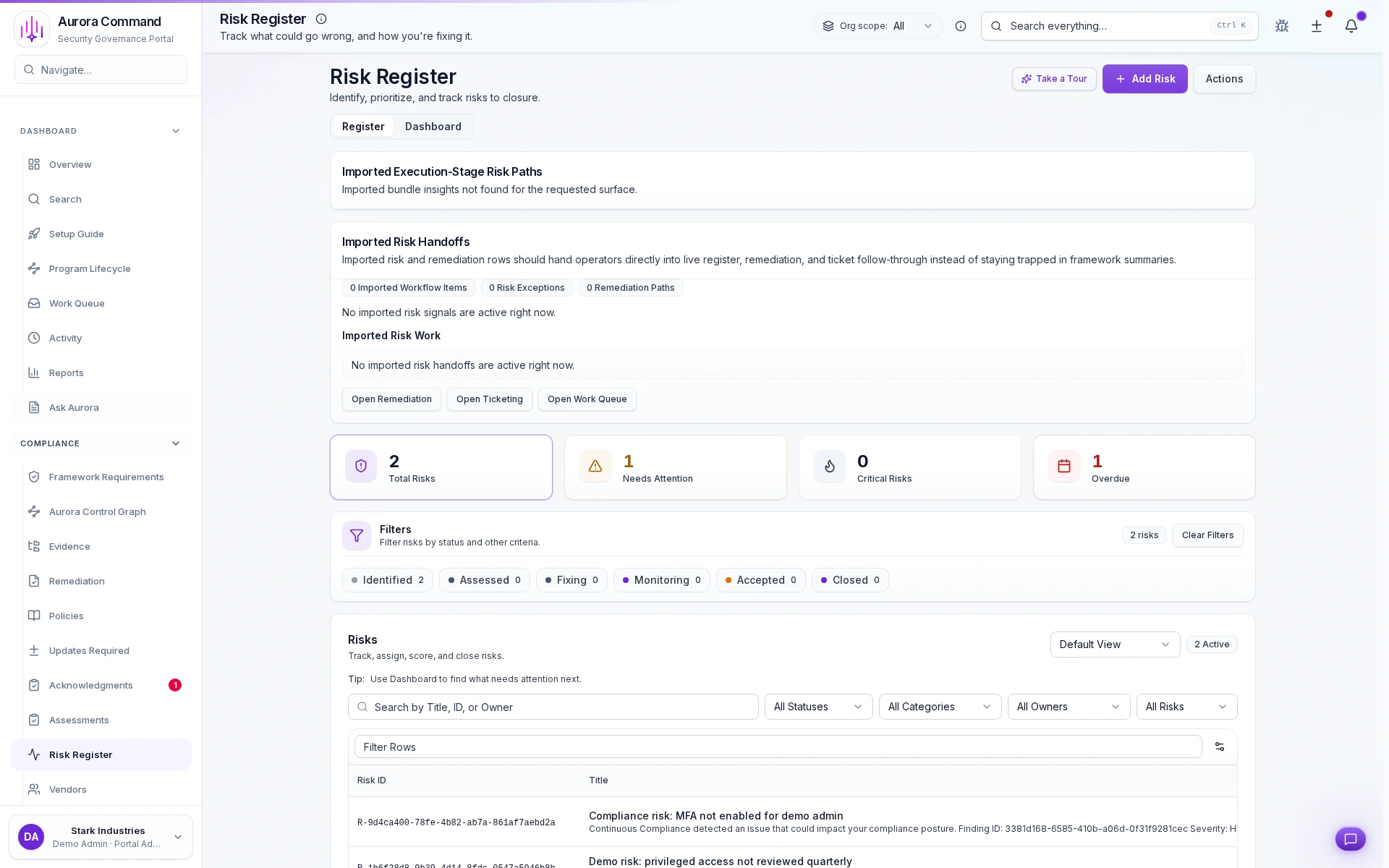
The accountability operating workspace
Surface the risks that need attention now
Walk each risk from identified to closed
Cite the finding behind every compliance risk
The Accountability Operating Workspace
risk register with closure state remediation owner + deadline trail support and message audit export
The Accountability Lifecycle: Capture, Assign, Track, Escalate, Close With Evidence
01
Capture Every Item Into One Accountable Queue
Risks, support asks, vendor follow-ups, and review-driven tasks enter a single governed intake instead of scattering across trackers, inboxes, and chat threads.
02
Assign a Name, a Deadline, and an Escalation Path
Every item gets a named owner, a due date, and escalation rules that fire before work goes overdue quietly - no more 'I assumed someone else had it.'
03
Track Treatment, Messages, and Status Changes
Treatment rationale, operational messages, and every status change stay attributable to a person and a timestamp - so when a reviewer asks why something closed or stayed open, the record answers.
04
Close With Evidence, Not Just a Status Toggle
Closure requires evidence. Aurora produces clean, reviewer-safe exports with decision trails, approval context, and timestamped completion records for auditors, insurers, buyers, and leadership.
05
Measure Whether the Queue Shrinks or Stalls
Trend views, SLA dashboards, and accountability scorecards show whether the team is closing work or quietly accumulating overdue items that will surface at the worst time.
Why Follow-Through Breaks When Accountability Lives Outside the Platform
Risks Get Logged but Never Verifiably Closed
Aurora keeps treatment rationale, remediation progress, and closure evidence in one unbroken chain - so 'marked as resolved' means something an auditor can verify, not just a checkbox someone toggled.
Support Requests Vanish Between Intake and Resolution
Aurora gives every support ask, advisory request, and review-driven follow-up a structured queue with assignment, SLA visibility, and a response trail that exports when reviewers come asking.
Operational Messages Disconnect From the Work They Reference
Aurora ties every escalation, status update, and decision message directly to the item it concerns - so the communication record and the accountability record are the same record.
Closure Artifacts That Prove Follow-Through Actually Happened
The Product Surfaces That Power Accountable Operations
01Risk & Accountability
The core record where risks, treatment rationale, named remediation owners, and timestamped closure evidence live together in one governed chain.
02Support Requests
The structured intake and assignment layer where operational review work, advisory asks, and follow-up requests get an owner, a deadline, and an exportable resolution history.
03Messaging Operations
The communication and escalation lane where status changes, outreach, and decision context stay attributable to the items and the people they involve.
04Vendor Risk
The same accountability model extended into vendor assessments, due-diligence tracking, and ongoing review cadence - so third-party follow-through gets the same rigor as internal work.
Reviews That Close Faster When Closure Evidence Already Exists
Buyer and Procurement ReviewsShow that every finding, exception, and remediation item is owned, progressing on a deadline, and closed with exportable proof - not just a narrative summary.Insurance and RenewalsDemonstrate operational follow-through with timestamped closure evidence instead of narrating progress across a chain of email threads and meeting notes.Vendor DiligenceKeep third-party review cadence, findings, reassessment work, and follow-up deadlines tied to one accountable queue that exports a clean diligence package on demand.
Straight Answers for Teams Buying Accountability Infrastructure
Why does Aurora separate proof from accountability?
Why does Aurora separate proof from accountability?
The proof record and the follow-through record solve different problems. Aurora keeps them connected - reviewers see both governed evidence and operational closure without forcing everything into one screen or one pricing line.
Is this only for risk registers?
Is this only for risk registers?
No. The same accountability layer handles support requests, operational messaging, vendor diligence, review-driven follow-ups, and closure exports. If it needs an owner, a deadline, and evidence of completion, it belongs here.
Can reviewers see closure evidence without seeing our full queue?
Can reviewers see closure evidence without seeing our full queue?
Yes. Aurora produces reviewer-safe exports and controlled sharing paths that surface the closure artifacts that matter - without exposing internal queue state, draft notes, or work-in-progress items.
How does this connect to ReviewOps?
How does this connect to ReviewOps?
ReviewOps is the commercial bundle that combines governed proof, automation, the accountability operating layer, vendor workflows, and additional review-project capacity into one package with clear, named pricing.
Close the Accountability Gap Before Your Next Review Exposes It.
Share the risk register, overdue remediation queue, vendor follow-up list, or support backlog that keeps slipping between cycles. We will walk through the accountable record Aurora produces - owner, deadline, and closure evidence for every item.
Share a framework, buyer request, questionnaire, or renewal packet. We'll show how Aurora handles it.